Missing a tooth can affect more than the appearance of your smile. It may also make chewing more difficult, change how your bite feels, and allow nearby teeth to shift over time.
Two common options for replacing missing teeth are dental implants and dental bridges. Both can restore your smile and improve function, but they work in very different ways.
At Smileworld Family Dental, treatment recommendations are based on your oral health, the location of the missing tooth, surrounding teeth, and your long-term dental goals.
What Is a Dental Implant?
A dental implant is a small post that is placed into the jawbone to replace the root of a missing tooth.
After the implant integrates with the surrounding bone, a custom dental crown is attached to restore the visible portion of the tooth.
A dental implant can function independently without relying on neighboring teeth for support.
What Is a Dental Bridge?
A dental bridge is a fixed restoration that fills the space created by one or more missing teeth.
A traditional bridge typically uses crowns placed on the teeth next to the gap to support an artificial replacement tooth between them.
Once placed, the bridge remains fixed in the mouth and is not removed for daily cleaning.
Dental Implants vs. Dental Bridges: What’s the Main Difference?
The biggest difference is how each restoration is supported.
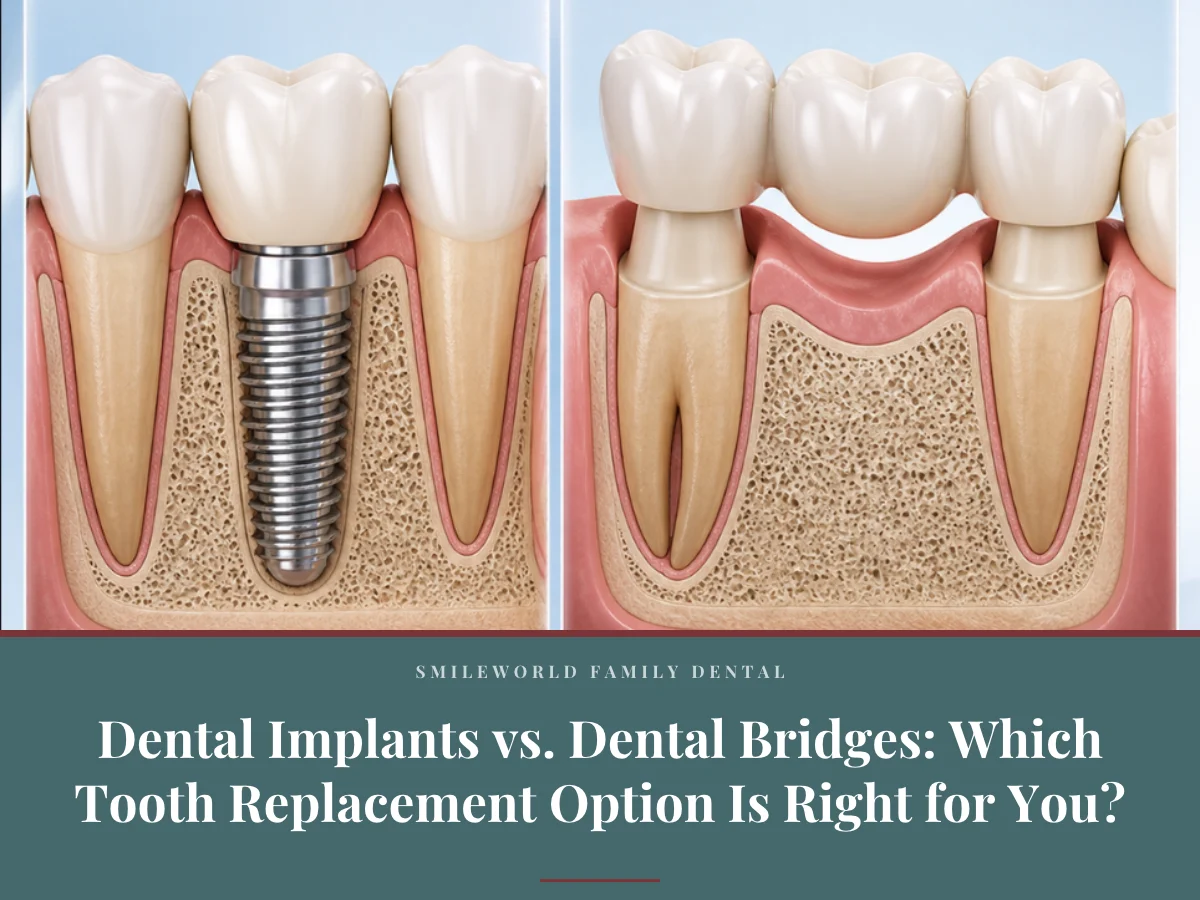
A dental implant is anchored into the jawbone and replaces both the missing tooth and its root.
A traditional dental bridge is supported by neighboring teeth and replaces only the visible portion of the missing tooth.
Both options can provide natural-looking results, but the best choice depends on your individual situation.
How Do Dental Implants Work?
Dental implant treatment generally involves several stages.
Implant Placement
The implant post is surgically placed into the jawbone where the missing tooth was located.
Healing and Integration
The implant needs time to bond with the surrounding bone. This process creates a stable foundation for the final restoration.
Final Restoration
Once healing is complete, a custom crown is attached to the implant to restore the appearance and function of the missing tooth.
The exact process and timeline vary depending on your oral health and treatment plan.
How Do Dental Bridges Work?
A traditional dental bridge usually involves preparing the teeth on either side of the missing tooth.
These teeth receive crowns that support an artificial replacement tooth in the middle.
The bridge is then cemented into place to create a continuous restoration across the gap.
Which Option Looks More Natural?
Both dental implants and bridges can be designed to blend naturally with surrounding teeth.
Modern dental materials allow your dentist to match the color, shape, and proportions of the restoration to your smile.
The final appearance depends on factors such as:
- Location of the missing tooth
- Gum health
- Surrounding teeth
- Material used
- Treatment planning
A personalized approach helps create the most natural-looking result.
Which Option Is Better for Preserving Bone?
Dental implants have an important advantage when it comes to jawbone preservation.
Because an implant is placed into the jawbone, it helps stimulate the bone similarly to a natural tooth root.
When a tooth is missing, the bone in that area can gradually shrink over time.
Traditional bridges replace the visible tooth but do not replace the root, so they do not provide the same type of bone stimulation.
Do Dental Bridges Affect Nearby Teeth?
Traditional dental bridges usually require the neighboring teeth to be reshaped so they can support crowns.
This may be appropriate when those teeth already need restorations.
However, if the neighboring teeth are completely healthy, a dental implant may allow them to remain untouched.
Your dentist will consider the condition of the surrounding teeth before recommending treatment.
Which Option Lasts Longer?
Both dental implants and bridges can last many years with proper care.
Their longevity depends on:
- Oral hygiene
- Gum health
- Bite forces
- Teeth grinding
- Smoking
- Regular dental care
- Overall health
Dental implants can provide long-term results when properly maintained, while bridges may eventually need replacement because of wear, decay, or changes in the supporting teeth.
Which Option Is Easier to Clean?
Dental implants are usually cared for similarly to natural teeth with brushing and flossing.
Dental bridges require additional cleaning beneath the artificial tooth to remove plaque and food particles.
Your dental team may recommend floss threaders, interdental brushes, or other cleaning tools to help maintain the area around a bridge.
Good oral hygiene is essential for both options.
How Long Does Treatment Take?
Treatment time can vary significantly.
Dental Implants
Implant treatment often takes several months because the implant needs time to integrate with the jawbone before the final crown is placed.
Additional procedures, such as bone grafting, may extend the timeline.
Dental Bridges
Dental bridges can often be completed more quickly because they do not require surgical integration with the jawbone.
Your dentist can provide a more accurate timeline after evaluating your specific situation.
Who May Be a Good Candidate for Dental Implants?
Dental implants may be appropriate if you:
- Are missing one or more teeth
- Have healthy gums
- Have adequate jawbone or are eligible for bone grafting
- Maintain good oral hygiene
- Are healthy enough for oral surgery
- Want an independent tooth replacement option
Certain medical conditions, smoking, or inadequate bone may affect candidacy.
Who May Be a Good Candidate for a Dental Bridge?
A dental bridge may be appropriate if you:
- Have one or more missing teeth
- Have healthy teeth next to the gap
- Prefer a non-implant option
- Are not a candidate for implant surgery
- Want a fixed tooth replacement
The condition of the supporting teeth is especially important when considering a traditional bridge.
Can You Replace Multiple Missing Teeth?
Yes.
Dental bridges can replace multiple adjacent teeth, depending on the location and health of the supporting teeth.
Dental implants can also be used to replace several missing teeth and may support an implant-supported bridge in some situations.
Your dentist will determine which approach offers the best balance of stability, function, and long-term oral health.
Which Option Is Right for You?
There is no single tooth replacement option that is best for everyone.
Your dentist will consider factors such as:
- Number of missing teeth
- Jawbone health
- Gum health
- Condition of neighboring teeth
- Bite
- Overall health
- Treatment timeline
- Long-term maintenance preferences
A comprehensive dental evaluation is the best way to determine which option fits your needs.
Why Choose Smileworld Family Dental for Tooth Replacement?
At Smileworld Family Dental, we take a personalized approach to restorative dentistry.
We evaluate your oral health, discuss your treatment goals, and explain the advantages and considerations of each tooth replacement option.
Whether a dental implant, dental bridge, or another restoration is right for you, our goal is to help restore your smile while supporting long-term oral health and function.